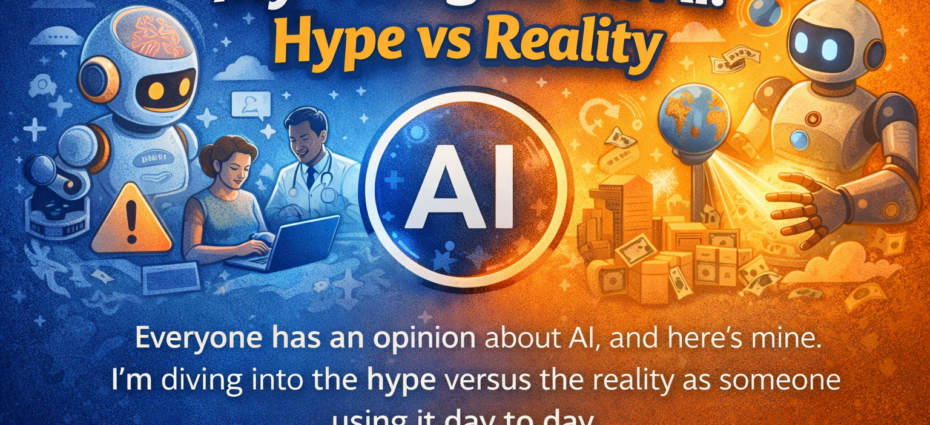
My Thoughts on AI: Hype vs Reality
What excites you most about AI right now?
AI is already reshaping web development, acting more like a thinking partner than a replacement. It helps speed up early ideas, debugging, and prototyping, but real development still relies on understanding trade-offs, architecture, and long-term maintainability. The role is evolving, not disappearing.
Which AI hype do you think is completely overblown?
AI can generate code, but software development isn’t just writing code — it’s understanding problems, trade-offs, long-term maintenance, and edge cases. The idea that developers will disappear completely feels unrealistic. If anything, the role just shifts.
Have you personally used AI tools in your work or daily life? Which ones?
I use AI less like an oracle and more like a thinking partner. It’s great for sketching ideas quickly, exploring options, or getting unstuck. Recently I even used it to help plan my garden layout. For coding I’ve mostly shifted toward tools like GitHub Copilot and Claude, which fit more naturally into my workflow.
Do you think AI will truly replace certain jobs, or just change how we work?
Like the combine harvester changed farming forever, AI will absolutely remove some roles entirely. But historically automation replaces certain types of work while creating others. The difficult part isn’t whether change happens — it’s how quickly it happens.
What’s the biggest misconception people have about AI?
One of the biggest misconceptions about AI is that it’s either not very useful or, on the other extreme, far more capable than it really is. In reality, most people are sitting somewhere between dismissal and hype. It can feel underwhelming if you expect magic, or overwhelming if you assume it’s replacing everything—but the truth is much more balanced. AI is already genuinely useful, but still heavily dependent on context, prompting, and human judgement, and it works best as a tool that extends capability rather than replaces it.
Are there ethical concerns about AI that worry you, or is it mostly overblown?
There’s a lot of discussion about the electricity and water usage of AI systems. Personally I think that concern is sometimes overstated. Historically, when technology increases energy demand, it also accelerates investment into better infrastructure. If AI increases the incentive to expand solar, wind, or nuclear capacity, that could end up being a positive long-term shift.
Which AI applications have actually improved productivity for you?
AI speeds up the first 10% of work dramatically, but often shifts effort into debugging and testing. So overall productivity doesn’t necessarily increase – it just moves to a different part of the process.
What would you say to someone who fears AI will take over creative fields?
I think creative professionals are right to be concerned. AI is already capable of producing convincing artwork, writing, and music. The bigger question isn’t whether AI can create – it’s how society values human-made work alongside machine-generated work.
What’s one thing people often forget about the limitations of AI?
People often talk about AI like it’s unlimited, but it isn’t. There are usage limits, subscription costs, API credits, and infrastructure requirements behind the scenes. If anything, we might eventually reach a point where the economics of AI become just as important as the technology itself.
How is AI changing web development tools like WordPress, and what impact do you think it will have on the industry and its competitors?
AI is speeding up initial ideas and concepts to fully polished products. Cloudflare has recently boasted a WordPress beater in it’s Em-Dash, but these competitors have hard work to beat the already 100,000s of WordPress plugins already out there and the WordPress architecture that’s been built over 20 years.
Looking ahead 5 years, what do you realistically think AI will be capable of?
I suspect the next five years will include a few genuine breakthrough moments that move things forward dramatically. But there’ll also be a lot of time spent trying to force AI into places where it doesn’t quite fit yet. Progress won’t be smooth — it’ll come in jumps.
About the Author

Stephen Ainsworth
Stephen is a web developer who has been building websites and applications for over a decade. He continues to build projects and solutions for clients and enjoys teaching others in his field.